
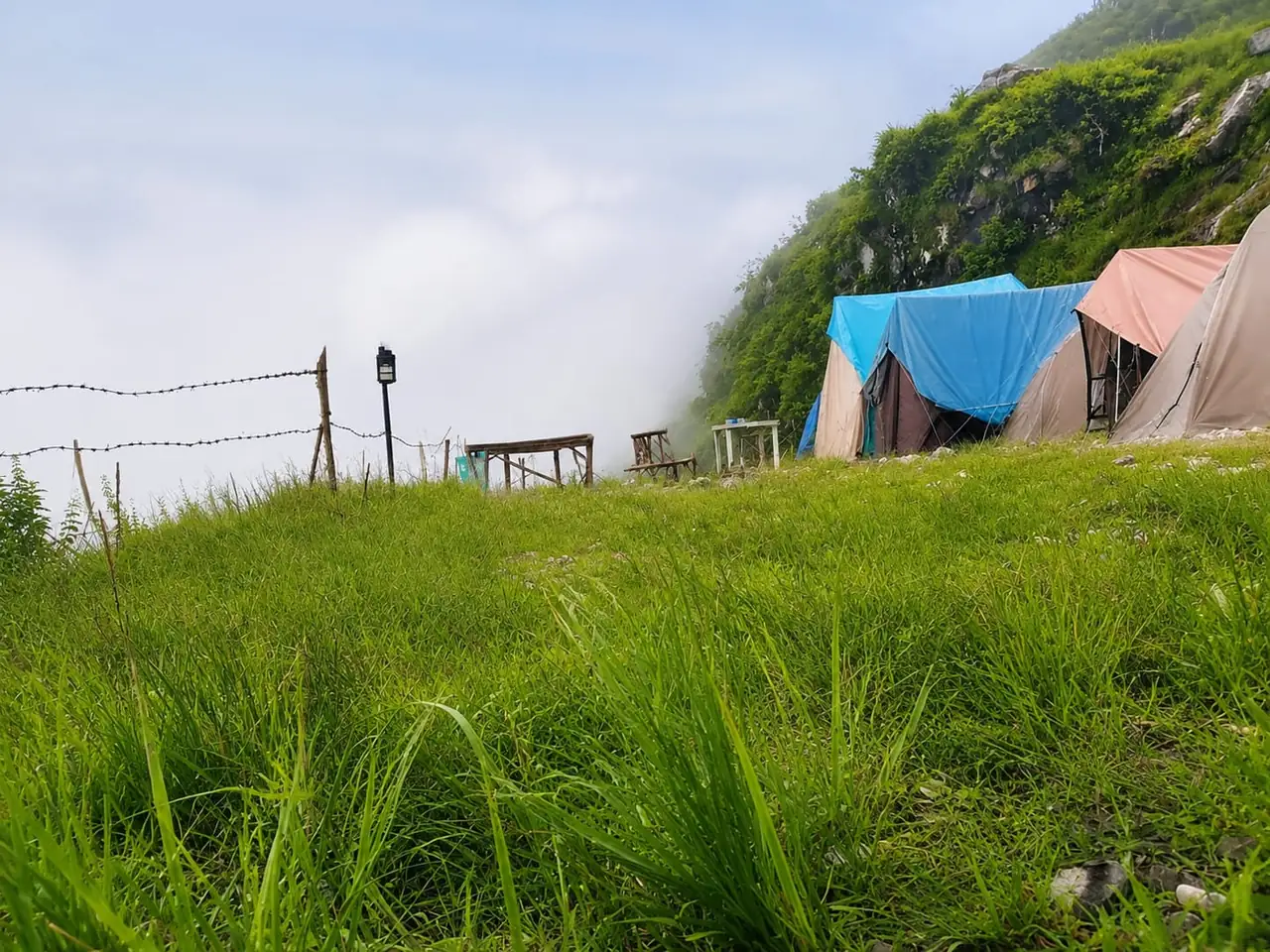
George Everest Peak sits at 7,054 feet on the western edge of Mussoorie, six kilometres past Mall Road on the Hathipaon ridge. Sir George Everest ran the Great Trigonometric Survey from up there between 1830 and 1843. His house is still standing, built around 1832, roof gone, walls and chimney intact. You walk through it on the way to the summit.
I should say at the start that I run one of the camps on this list. Camp George Everest is ours. The others are not, and I have tried to be straight about which one you should book, including the cases where the answer is not us.
Raw camping or glamping
Everything at George Everest splits into two kinds of stay, and the price follows from which one you pick.
Raw camping means you walk in. The tent is a tent. The bathroom is shared, the bonfire is shared, dinner is cooked in one pot for everybody. No AC, no Wi-Fi, no room service. A guest of ours put it well in a review: the raw thrill of camping at the peak. That is about right. It runs ₹1,300 to ₹2,500 a person.
Glamping means you drive to the door. Proper bed, attached bathroom, hot water, a bonfire lit for your unit alone, somebody bringing you breakfast. It runs ₹4,500 to ₹22,000 a night.
Both are fine. They are not the same holiday, and nearly every complaint I hear about camping in Mussoorie comes from someone who booked one while expecting the other.
Prices below are the bands I was seeing in August 2026. Rates in Mussoorie move with the season and the booking site, so treat them as bands, not quotes.
1Camp George Everest
₹2,000 / person · meals included · on the peak
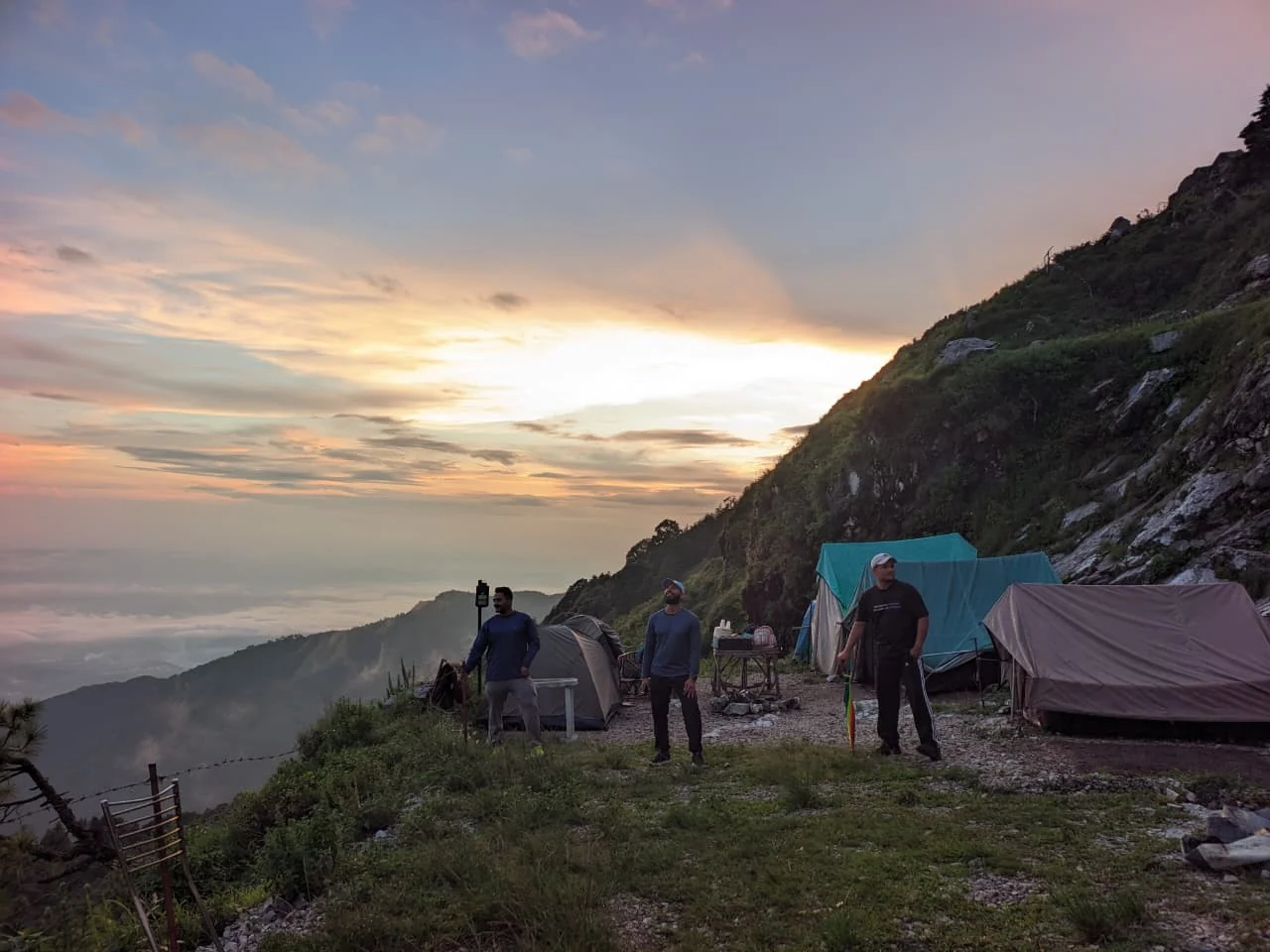
We are on the peak itself, in the Park Estate. You drive to the gate, park free, and walk two kilometres through pine and deodar to the campsite. It takes 30 to 45 minutes at an easy pace and our guides carry the heavy things. That walk is the whole difference between us and most listings that say “Mussoorie camping” while sitting on a roadside lot at 4,000 feet.
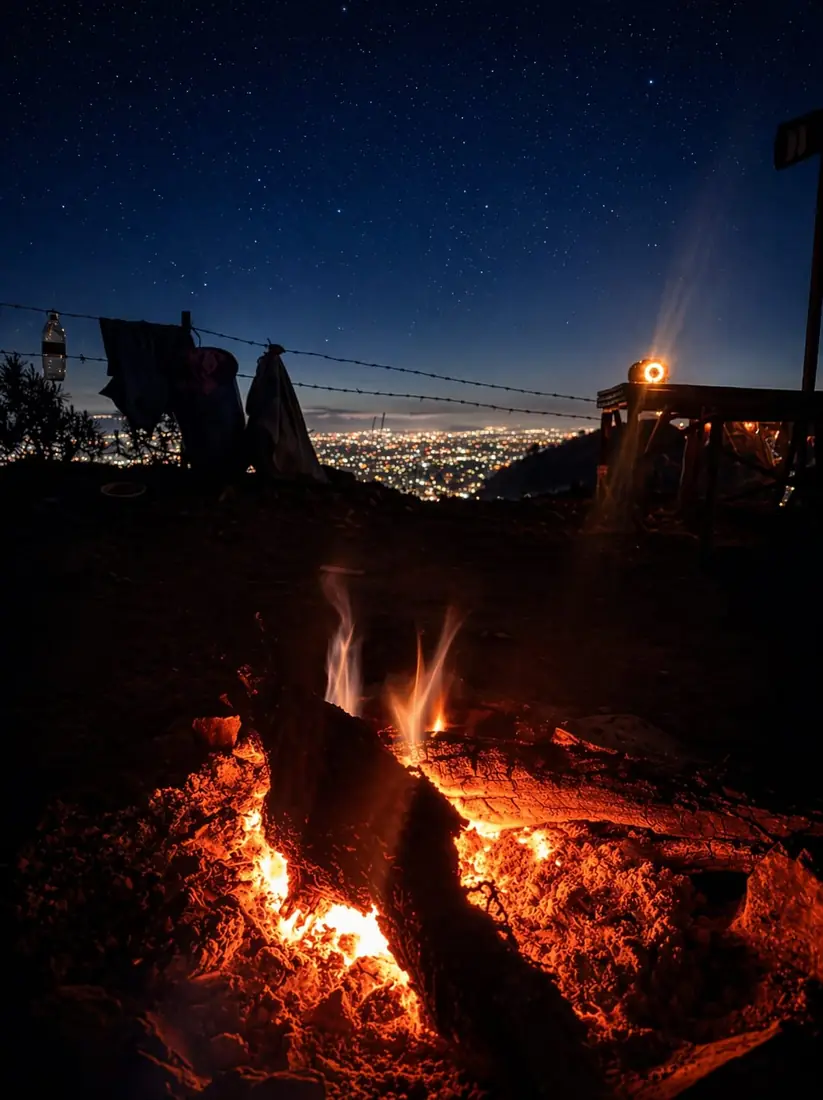
The ₹2,000 covers a Quechua tent already pitched with sleeping bags and mattresses, the guided trek up, dinner and breakfast cooked on site, evening chai, the bonfire, and a telescope session. There is a self-cooking activity if you want to make your own dinner over the fire, and most groups try it once. At 5 in the morning we walk to the summit for sunrise, everyone in one mixed group.
The walk in
Two kilometres from the Park Estate gate, 30 to 45 minutes, through pine and deodar with some oak lower down. It is moderate. First-time trekkers manage it fine, our guides set the pace, and the heavy bags go up with them rather than on your back. In March and April the rhododendron is out along the trail.
The gate is where you park and where the walk starts. Open it in Google Maps.
You pass the Park Estate House on the way. That is Sir George Everest’s own residence and observatory, built around 1832. The roof went long ago but the walls and the chimney are standing, and the Uttarakhand government has been slowly restoring it. Give it ten minutes.
Further along the ridge there are still Great Trigonometric Survey reference marks set in brass and stone. They are small and easy to walk straight past. The mapping of the Indian Himalaya began here.
Sunrise at the summit
We leave camp at 5. On a clear morning Bandarpunch stands straight to the north at 6,316 metres, with the Swargarohini twins beside it and the Gangotri group further east. Look the other way and the Doon Valley runs south towards Dehradun and Haridwar.
Carry a torch for the walk up. And the shoes matter more coming down than going up.
Phone signal is patchy. Jio and Airtel work in some spots on the ridge, Vi mostly does not. That is deliberate, and if you need to be reachable for work, plan around a few hours offline each evening.
Around 70% of our weekend bookings are people between 18 and 30. Friend groups out of Delhi, college trips from Dehradun and Chandigarh, first-job couples from Gurgaon and Noida. The bonfire is shared across groups rather than split per booking, which is the part people remember. By nine at night, three sets of strangers are usually one group trading songs. Solo travellers do well here for the same reason.
Whole-camp buyouts start from 25 people, and group rates are custom.
More detail on the site: Camp George Everest, and the two experiences most people ask about, stargazing and bonfire nights and the sunrise summit walk.
2Everest Base Camp Mussoorie
₹10,500 to 22,000 / night · glamping · Hathipaon Road
The luxury option on the same ridge, on Hathipaon Road at 2,160 metres. They opened in 2019 and now run fourteen accommodations inside a deodar forest, from The Camper at the entry end to Andrew’s Villa at the top. Roughly ₹10,500 for the smaller tents, ₹15,000 to ₹18,000 for the Surveyor suites and the cottages, ₹22,000 and up for the villa in peak weeks. Pets are allowed at a surcharge.
If you want plumbing, a private bonfire and someone to bring you dinner, book this and do not think twice. Their Park Cafe is genuinely good and takes walk-ins, so you can eat there even if you are staying elsewhere. Wood-fired pizza at that altitude is not a small thing.
One honest note. Their reviews keep mentioning that breakfast does not start until 8:30 or 9. If you are up for sunrise on the ridge, eat when you come back down, or carry something with you.
3GMVN George Everest Nature Camp
3 days, 2 nights · minimum 10 people · state-run
The state-run option, from Garhwal Mandal Vikas Nigam, inside the Park Estate. It is a three-day, two-night programme in alpine tents built around stargazing, astrophotography, birdwatching and beginner rock climbing. Minimum ten people, maximum twenty-five.
For a school group or a college department trip that needs a government booking trail and paperwork that a principal will sign off on, this is the straightforward choice. For two people on a Saturday, it is not, because of the minimum group size.
4Anantaa Pranaa
₹4,500 to 5,000 / night
The middle of the market, and there is not much else sitting in it. Worth knowing about if ₹2,000 feels too rough for the people you are travelling with and ₹15,000 feels absurd for one night, which is a fair position to hold.
5Treetop Glamps and Manzil Escapes
₹12,500 to 20,000 / night · not on the peak
Both are dome glamping, sold on the view. Treetop averages ₹12,500 a night. Manzil Escapes is on Kempty Fall Road and its sunset dome with the private garden goes up to ₹20,000.
Both are comfortable and both photograph beautifully. Neither is on George Everest Peak, so if you have come specifically for the peak and the survey house, check the map before you book. Kempty is a different side of Mussoorie altogether.
6The budget dome camps
₹1,300 to 1,750 / person · roadside, 4,000 to 5,000 ft
Along the Hathipaon road there are several operators running dome tents at the bottom of the market, usually a one-night two-day package with a buffet dinner of dal, paneer, jeera rice and chapati, breakfast of parantha or chholey bhature, and a group bonfire.
I am not going to be rude about these. For a college group counting rupees, one night in a dome tent with a bonfire is a real trip and a good memory. Know what you are buying, though. You get hill air rather than a peak, and the tent is shared with more people than you would pick.
7Eco camps on the Bhadraj temple road
rustic · on the trail
These are rustic and smaller, aimed at people walking the Bhadraj trek rather than sightseeing. The standard route to the temple is a steep five kilometres from Dudhli, though plenty of walkers start from the Cloud’s End and George Everest side instead. Book here if the trip is mainly the hike and you want to sleep near the trail.
What the night costs beyond the tent
The tent price is not the trip price, and this is where budgets slip.
Getting up from Dehradun is 35 kilometres and an hour and a half by cab. Mussoorie’s taxi unions and the app-based cabs have an ongoing fight, so do not assume you will open Uber at Dehradun station and be sorted. For groups we arrange shared or private vehicles from the station or the airport, and it is worth asking rather than negotiating on the pavement at midnight.
The George Everest Adventure Park sits right there and most people end up doing something. Packages run ₹1,500 for the Silver set of sky bridge, monkey swing and zip line, ₹2,700 for Gold, ₹5,600 for Diamond, with a few hundred off if you pay online. Their Sky Ride is the one everyone comes for: 2,000 feet long, 600 feet above the valley floor, ₹1,500 on its own.
We also run the Pudina Khet nature walk through the herb gardens and oak forest as an add-on at ₹500 a head, which you can decide about at check-in rather than in advance.
When to go
March to June. Days are pleasant, skies are clear, the trek runs at full operation and the sunrise window is longest. This is also when weekends fill, so book two to three weeks ahead.
October to early December. The cleanest air of the year and the best stargazing we get. The Geminids peak around 13 and 14 December and are worth planning a trip around. This stretch is my own favourite and it is quieter than summer.
Mid-December to February. Cold, sometimes snow, heavy bonfires. Mussoorie also gets the winterline in these months, a false horizon of colour bands after sunset that you can see from very few places. We suspend operations on heavy snow days.
July to September. Do not. The trail turns slippery, the views disappear into cloud and most camps here scale back. Come in October instead.
Getting there, and the one thing to carry
Delhi is 290 kilometres and six to seven hours by road. Dehradun is 35 kilometres and an hour and a half. Jolly Grant airport is 60 kilometres, two hours. From Mall Road it is six kilometres and twenty minutes to the Park Estate gate, then the two-kilometre walk.
Carry proper trekking shoes. We say this to every single booking and people still turn up in sneakers. Everything else you can borrow or do without. Warm layers even in May, a torch or headlamp, a water bottle, a light backpack for the walk. Tents, sleeping bags, mattresses and food are on us.
How to book
WhatsApp us with your dates, how many of you there are, and whether you want the trek. During the day we usually come back within the hour and send a secure payment link. Asking costs nothing and there is no payment to enquire. You can also use the booking card on the Camp George Everest page.
Book by when. Two to three weeks ahead for any weekend between March and June, and for every long weekend. Midweek and through October, a few days is usually enough.
Groups. Send the headcount and a rough budget and a real number comes back the same day, with meal plans, transport options and add-ons like a projector, a DJ or a photographer. Whole-camp buyouts start from 25 people.
Solo. You are welcome, and a lot of our regulars came alone the first time. There is a DIY community WhatsApp group for finding dates and sharing a cab out of Delhi or Dehradun.
Not included. Transport to the gate, personal trekking gear, alcohol, travel insurance and the Pudina Khet walk. Better to know now than at the base point.
If you decide a tent is not for you after all, we have a rooftop cafe and homestay in town at Seegreen, which looks across at this same peak, and the rest of our places are on Our Stays.
Come up on a clear night in late October. Stand on the ridge after dinner with the fire behind you, and the whole Doon Valley is lying below in lights, all the way to Dehradun and past it toward Haridwar. Then turn around and look north, and there is nothing at all except Bandarpunch with snow on it.
 Mountain Stays